Blog
How to calculate tree trim height along a microwave hop
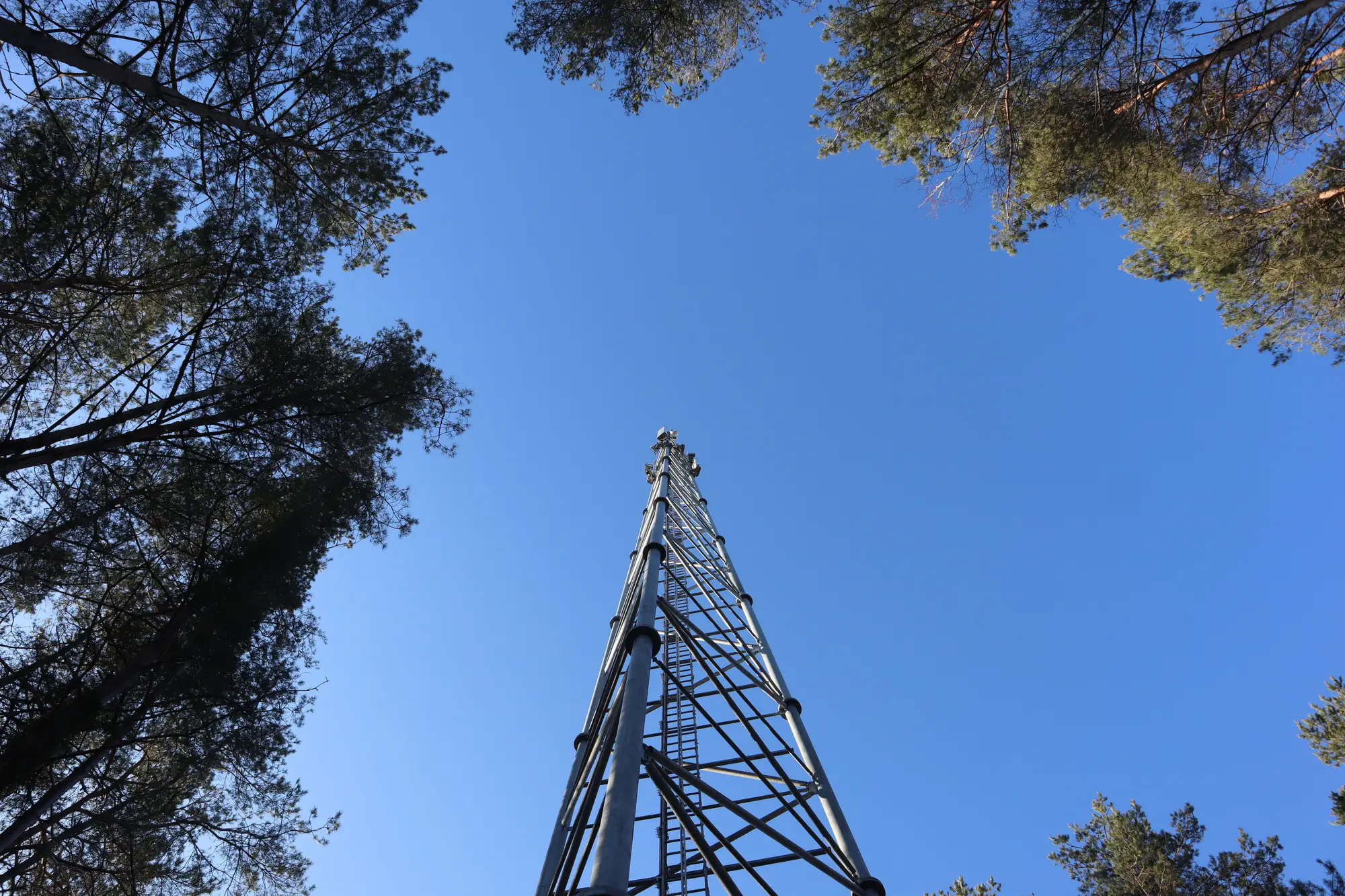
Most people who ask this question already have the hard part done: they know a tree is close to the path, they just need a number to hand to the trim crew. The trim height is the amount that has to come off the top so the canopy sits below your clearance envelope, with enough margin that it doesn't need a second visit before next year's pass.
Start with the Fresnel envelope, not the tree
Before you can say how tall is too tall, you need the radius of the first Fresnel zone at the tree's location along the path. The standard formula:
F1 = 17.32 × √(d1 × d2 / (f × D))
where d1 and d2 are the distances from each end to the obstruction in km, f is frequency in GHz, D is total path length in km, and F1 comes out in meters. Most operators don't clear the full F1 radius everywhere. The common planning rule is 60% of F1 clear of any obstruction for a standard link, with high-priority or long hops often designed to the full radius for the availability margin it buys. Which number you use is a design decision made before any tree enters the picture, and it changes the answer by a meaningful amount, so confirm it against your own link budget rather than borrowing a rule of thumb from a different band or path length.
Build the line-of-sight height before you subtract anything
The Fresnel radius tells you how wide the clearance zone is at that point. It doesn't tell you how high the beam sits above the ground there. For that you need the line-of-sight (LOS) elevation at the tree's distance along the path, which comes from straight-line interpolation between your two antenna heights above sea level, adjusted for earth curvature using the standard 4/3 earth radius (k-factor) model. On a 20 km hop that bulge can be several meters at midpath, easy to forget if you're eyeballing a profile instead of running the numbers.
Once you have LOS height and Fresnel radius at that point, your maximum allowable obstruction height (the ceiling, in meters above sea level) is:
Allowable height = LOS height − (clearance fraction × F1)
Everything above that line sits inside the zone, whether it's touching the centerline or just grazing the edge of the 60% envelope.
Where the actual trim number comes from
This is the step people skip. Allowable height marks a line in space. Trim height is the difference between where the canopy top sits and where that line falls:
Trim amount = canopy top elevation − allowable height
If your canopy survey puts the top of a stand at 412.4 m ASL and your allowable height at that chainage comes out to 409.8 m, the crew needs to take 2.6 m off the top, not bring the tree down to some arbitrary stump height. Build in a growth buffer on top of that raw number. A species growing 0.5 to 1 m a year will eat back into the envelope well before your next pass if you cut it exactly to the line, so most planners add a season or two of expected growth to the trim depth and sign off on that instead.
Run that calculation by hand per span and it's an afternoon of work for one hop. Run it across a hundred spans and it's the kind of task that gets pushed to "after the next outage" instead of done ahead of it. The annual canopy-height pass we run against the clearance envelope for each link on Link Vegetation Monitor turns that math into a flagged clearance problem with a height number already attached, for every span where the canopy sits inside the envelope.
If you'd rather see which of your hops already have canopy sitting inside the envelope than calculate it span by span, that's the report to start with.